

Eye creams have a reputation problem. Half the internet says they are a scam invented by beauty brands to sell you a moisturizer in a tiny jar. The other half swears they transformed their under-eye area in four weeks. After six years working as a licensed esthetician and another three years reviewing skincare products on my own skin, the honest answer sits somewhere in the middle. Eye creams cannot fix every cause of dark circles, and I will tell you plainly when concealer is your better option. But for the right type of darkness, the right formula does make a measurable difference.
The product I reach for most consistently is the Neutrogena Rapid Wrinkle Repair Retinol Eye Cream. It has 24,558 Amazon reviews and a 4.4-star average, which is exactly the kind of rating that tells you it works for most people while being honest enough not to pretend it works for everyone. At current pricing it costs less than a single department store sample sachet. Below are 10 reasons a targeted eye cream, used consistently, can genuinely move the needle on dark circles and puffiness.
Your under-eye area is thinner and more reactive than the rest of your face. It deserves a formula made for it.
The Neutrogena Rapid Wrinkle Repair Retinol Eye Cream combines retinol with glucose complex in a concentration calibrated for the delicate periorbital skin. Over 24,000 reviewers. Currently available on Amazon.
Amazon Check Today's Price on Amazon →Retinol Speeds Up Cell Turnover in a Zone That Stagnates Easily
The skin under your eye is among the thinnest on your face, which means it loses moisture faster and renews itself more slowly than your cheeks or forehead. Retinol, a vitamin A derivative, signals skin cells to cycle more quickly. This matters for dark circles because surface pigment brought on by sun exposure or post-inflammatory hyperpigmentation moves out faster when cell turnover is higher. Neutrogena's formula uses a stabilized retinol combined with glucose complex to deliver this benefit without the flaking that unformulated retinol often causes in the orbital area.

A Good Eye Cream Is Formulated Thinner Than Your Facial Moisturizer
Most face creams are too occlusive for the tissue directly under your eye. When you apply a dense moisturizer there, it can pool in the orbicularis muscle crease and actually emphasize fine lines by the time it warms to skin temperature. Eye creams are typically emulsified at a lighter viscosity specifically so they absorb without migration. That means less puffiness from occlusion and fewer instances of the product traveling toward your eyes and causing morning irritation.
Caffeine Supports Lymphatic Drainage to Reduce Morning Puffiness
Puffiness under the eyes is largely a lymphatic and vascular issue. Fluid pools overnight because you are horizontal and blood flow to the face slows. Topical caffeine is a vasoconstrictor that supports drainage when applied in the morning. Many eye creams include it for this reason. Look for it in the first third of the ingredients list to know you are getting a meaningful concentration. This will not solve structural puffiness caused by bone anatomy or fat pad descent, but for everyday morning swelling it consistently helps.
Retinol Thickens the Dermis Over Time, Which Reduces Vascular Show-Through
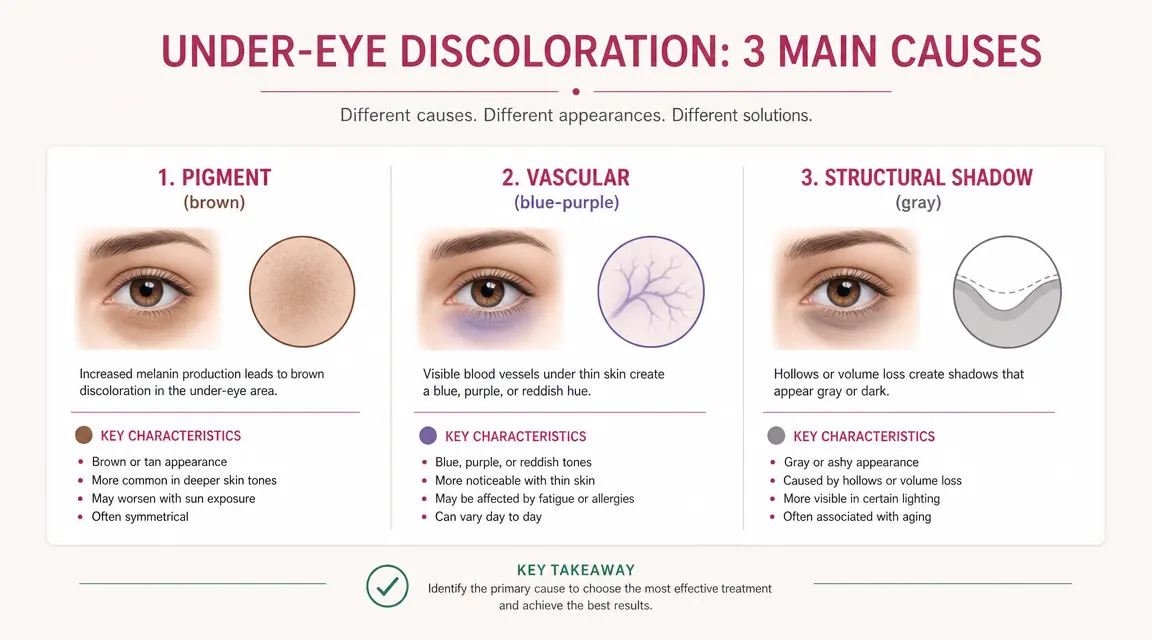
One reason the under-eye area looks purple or blue is not surface pigment at all. It is the capillaries below the skin showing through because the dermis is thin. Retinol, used consistently over several months, stimulates collagen production and measurably thickens the dermis. A thicker dermis means the vascular network is less visible from the surface. This is a slow change, not a two-week fix, but it is a real one backed by decades of clinical research on retinoids.
Hydration Temporarily Plumps Fine Lines That Cast Shadow
Some of what reads as dark circles is actually shadow from fine lines and crepey texture. When you hydrate and temporarily plump that skin with hyaluronic acid or glycerin, the texture smooths and the shadow it casts disappears, at least while the hydration is working. This is temporary and cosmetic rather than structural, but it is why so many people say their under-eye area looks better within a week of starting a consistent eye cream routine.
Eye creams cannot undo structural shadow from bone anatomy or fat pad descent. But for pigment-based and vascular darkness, a consistent retinol formula is one of the few topical options with real clinical backing.
The Right Formulation Minimizes Milia Risk Compared to Reusing Your Face Cream
Milia are tiny white cysts that form when keratin gets trapped under the skin. They are common in the orbital area, partly because people use rich face creams there that the thin skin cannot fully absorb. Eye creams formulated for the periorbital zone avoid the heavy waxes and comedogenic oils that contribute to milia. If you have ever developed a cluster of small white bumps under your eyes after using a richer night cream, switching to a purpose-built eye cream usually solves it.
Consistent Nightly Application Compounds Results That Sporadic Use Does Not
One of the biggest reasons eye creams fail for people is inconsistency. Retinol in particular requires sustained nightly application to accumulate the collagen-stimulating effect. Most people see meaningful texture improvement between six and twelve weeks of nightly use. The Neutrogena Rapid Wrinkle Repair formula is packaged in a tube with an applicator tip, which makes applying a consistent amount each night easy enough that most people actually stick to it. Ritual matters as much as formula.

SPF-Containing Eye Products Help Prevent New Pigment From Forming
Sun exposure is one of the primary drivers of pigment-based dark circles. If you are using a retinol eye cream at night to fade existing pigment but spending the day in UV without protection at the orbital zone, you are refilling the bucket faster than you can empty it. Some eye creams include SPF for morning use. If yours does not, extend whatever facial SPF you use to the outer orbital area every morning. This single habit makes retinol-based fading significantly more effective.
Lower-Concentration Retinol Is Appropriate for the Periorbital Area Specifically
The orbital rim is where many people experience their first retinol irritation because they apply a full-face serum too close to the eye. Eye creams formulated for the under-eye zone use a lower active concentration and buffer it with moisturizing ingredients that slow absorption and reduce the chance of sensitivity. This is not a weakness in the formula. It is precision. The Neutrogena eye cream is designed to deliver benefit at a pace the tissue there can handle, which is why it works for a wider range of skin types than stronger options.
A Targeted Product Earns More Consistent Application Than a Workaround
The behavioral reality of skincare is that when something is purpose-built for a specific area, people use it there. When they are told to dab their regular moisturizer under their eyes, they often skip it. Having a dedicated eye cream on the nightstand signals that the step matters. That signal creates the consistency that creates results. If you have been putting off the under-eye area because you thought any face cream would do, this is the reminder that giving it its own product is both useful and worth the small extra step.
What I Would Skip
If your dark circles are deeply structural, meaning the shadow comes from the shape of your orbital bones or a significant descent of the under-eye fat pad, no topical product is going to resolve that. This type of darkness looks the same whether you are well-rested or not, and it tends to be worse in raking side-light. Concealer is your effective, immediate option. Filler is a more lasting one if you want to explore that route with a provider. I say this not to discourage you from eye creams but to give you accurate expectations so you are not disappointed when a good product does not fix a problem it was never designed for. For pigment-based and vascular-based darkness, the evidence for consistent retinol use is genuinely solid.
Give retinol eight weeks before you judge it. The science on collagen stimulation is real, but it works on a biological timeline, not a weekend.
If your darkness is pigment or vascular, retinol at night is the most evidence-backed topical step you can take.
The Neutrogena Rapid Wrinkle Repair Retinol Eye Cream is a practical, well-reviewed place to start. Formulated for the periorbital area, consistent-use friendly, and available at a price that makes committing to eight weeks of nightly use an easy decision.
Amazon Check Today's Price on Amazon →